

TL;DR:
- Home exchange offers a cost-effective, immersive alternative to traditional accommodation by swapping homes.
- Trust and safety are built through verification, reviews, communication, and careful preparation.
- Flexibility and a positive mindset enhance the experience, emphasizing dialogue over perfection in travels.
Affordable travel does not have to mean budget hostels or cramped rooms. Yet millions of travellers spend hundreds, even thousands, on accommodation every year without realising there is a well-established alternative sitting right under their noses. Home exchange involves swapping homes with another party for accommodation during travel, and it has been quietly transforming how adventurous, cost-conscious people see the world. This guide breaks down the core models, eligibility, trust mechanisms, and practical logistics so you can decide whether home swapping belongs in your travel plans.
Table of Contents
- Understanding the home exchange landscape
- Eligibility: Who can participate in home exchange?
- Building trust and safety in home swapping
- Practicalities and pitfalls: Handling logistics, valuables, and extras
- What most new home exchangers miss: The mindset shift that matters
- Ready to try home exchange? Make your next adventure easier
- Frequently asked questions
Key Takeaways
| Point | Details |
|---|---|
| Main home exchange types | Simultaneous, non-simultaneous, points-based, and hospitality exchanges each offer different flexibilities. |
| Eligibility for all | Both homeowners and renters can participate if legal and lease requirements are followed. |
| Trust and safety | Verification, reviews, and transparent communication make home exchanges surprisingly safe and reliable. |
| Plan logistics well | Managing house rules, valuables, and special requests ensures a smooth, enjoyable exchange for everyone. |
| Mindset matters | Embracing flexibility and open-mindedness leads to the best home swap experiences. |
Understanding the home exchange landscape
Home exchange is not a recent invention dreamed up by Silicon Valley. Its roots stretch back to the 1950s, when teachers and academics began arranging informal swaps during summer breaks, staying in one another’s homes to keep travel costs manageable. The concept has since evolved into a global movement, supported by dedicated platforms and verified communities numbering in the hundreds of thousands.
So how does home exchange differ from a standard rental or timeshare? With a rental, you pay for someone else’s space. With a timeshare, you purchase the right to use a property during a fixed window. Home exchange removes the financial transaction entirely. Instead, you offer your own home in return for theirs, creating a relationship built on reciprocity rather than commerce. The result is an immersive local experience that a hotel simply cannot replicate: a neighbourhood grocery run, a favourite local café, the texture of daily life somewhere new.
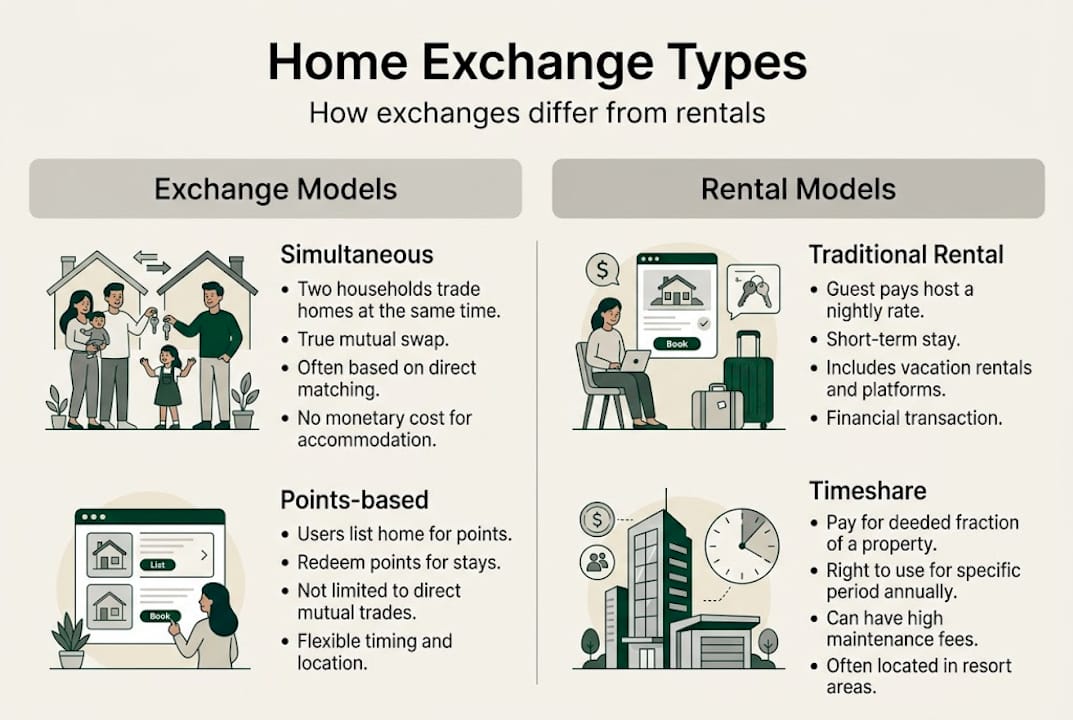
The key types include simultaneous reciprocal, non-simultaneous reciprocal, points/credits, and hospitality exchanges. Here is how they compare:
| Type | How it works | Best for | Flexibility |
|---|---|---|---|
| Simultaneous reciprocal | Both parties swap at the same time | Couples, families with fixed dates | Low |
| Non-simultaneous reciprocal | Swaps happen at different times | Travellers with flexible schedules | Medium |
| Points/credits | Host earns credits to spend elsewhere | Solo travellers, frequent exchangers | High |
| Hospitality exchange | Host stays present during your visit | Social travellers, cultural immersion | Variable |
Each model suits a different kind of traveller. Simultaneous swaps demand coordination but require the most trust upfront. Points-based systems offer the greatest scheduling freedom, which is why many first-timers gravitate towards them. Platforms offering safe, affordable swaps often support multiple models, giving members room to experiment.
- Simultaneous swaps: High coordination, strong personal connection, zero cost.
- Non-simultaneous swaps: More planning needed, but ideal for families with school-term constraints.
- Points/credits: Maximum flexibility; earn by hosting, spend anywhere on the platform.
- Hospitality exchanges: Great for cultural connection but requires comfort with shared space.
Eligibility: Who can participate in home exchange?
Understanding the types of exchanges is one thing, but are you actually eligible? Here is what you need to know, whether you own or rent.
Homeowners have the most straightforward path. You own the property, so the primary considerations are your home insurance policy, any mortgage conditions, and whether co-owners (a partner, for instance) agree to the arrangement. Most standard home insurance policies do not automatically cover home exchanges, so it is worth reviewing your policy carefully before listing. Check insurance considerations specific to house swapping before you proceed.

For renters, the situation is more nuanced. Renters can participate if their lease allows subletting or short-term guests, but this is never something to assume. Lease agreements vary enormously, and some explicitly prohibit any third-party occupation, even for a weekend.
Here is what renters should check before joining:
- Subletting clauses: Does your lease explicitly allow or prohibit subletting?
- Guest restrictions: Some leases limit how many consecutive nights a guest may stay.
- Landlord approval: Even where not legally required, written consent is wise and builds goodwill.
- Building rules: Managed blocks and leasehold properties may have separate rules from the lease itself.
- Home insurance: Renters’ contents insurance may not cover third-party occupation; upgrade if needed.
Regional variation also matters. In some European cities, local regulations around short-term occupation have tightened significantly, and home exchange is not always exempt. Always verify local rules alongside your lease.
Pro Tip: If you are a renter unsure about your lease, draft a short, polite email to your landlord explaining what home exchange is and asking for written permission. Frame it as a one-off trial and emphasise that no money changes hands. Many landlords are far more open to this than tenants expect, especially when you reassure them that the platform verifies all members. A full step-by-step guide can help you understand what to prepare before approaching your landlord.
Once eligibility is confirmed, the next step is joining one of the trusted exchange platforms that handle verification and matching for you.
Building trust and safety in home swapping
Knowing you can participate, the next concern most first-timers have is safety. Let us explore how trust is created and earned in home exchange communities.
The biggest psychological hurdle for new home exchangers is the idea of strangers sleeping in their bed, using their kitchen, and living in their space. It feels exposing. But the mechanisms that reputable platforms use to build trust are surprisingly robust.
“Home exchange platforms are a bit like online dating for your house. You browse profiles, read reviews, exchange messages, and only commit when you feel confident. The difference is the stakes are a comfortable holiday, not a relationship.”
Trust is built through reviews, verification, mutual reviews, and open communication. Most platforms require identity verification and photographs of the property, and many encourage video calls before any agreement is finalised. Here is a step-by-step approach to assessing platform safety:
- Check member verification: Does the platform verify government-issued ID?
- Read reviews thoroughly: Look for recent, detailed reviews rather than brief one-liners.
- Examine the review and verification systems: Does the platform prevent members from only leaving positive reviews?
- Request a video call: A short call tells you a great deal about someone’s character and intentions.
- Assess communication quality: Prompt, clear, and warm messages are a reliable indicator of a conscientious exchanger.
- Read the platform’s support policies: What happens if something goes wrong? Know before you commit.
Insurance remains a separate but critical layer. Platforms typically do not provide comprehensive cover for damage or theft, so your own home insurance must be reviewed. The safety tips for house swapping available through SwapSpace are a useful reference for understanding exactly where platform responsibility ends and personal cover begins.
Pro Tip: Always complete a video call with your exchange partner before confirming. It takes fifteen minutes and can save weeks of anxiety. Ask practical questions: where is the boiler, do the windows lock, what is the WiFi password? The answers matter less than the conversation itself, which quickly reveals whether the other person is someone you trust with your home.
Practicalities and pitfalls: Handling logistics, valuables, and extras
Building trust is only half the battle. The day-to-day logistics matter just as much for a successful exchange.
Preparing your home properly is not about making it perfect. It is about making it clear, comfortable, and safe for someone who has never been there before. A well-written house manual is arguably the single most valuable thing you can create. Include information on appliances, emergency contacts, recycling routines, and any quirks the property has.
Practical preparation covers valuables storage, car swap permissions, and care arrangements for pets and plants. Key areas to address:
- Valuables: Lock away documents, jewellery, and sentimental items in a dedicated cupboard or secure box.
- House rules: Set clear expectations around smoking, visitors, and noise in writing before the swap.
- Pets and plants: Negotiation is key. Some exchangers are delighted to care for a cat; others are not. Agree in advance and confirm in writing.
- Shared transport: If you are swapping cars, check your motor insurance explicitly covers named drivers or short-term users.
- Cleaning expectations: Specify whether the home should be left as found or whether a cleaner is arranged.
| Common problem | Practical solution |
|---|---|
| Dates do not match | Use a points/credits exchange to decouple timing |
| Partner seems unreliable | Request a video call and read all available reviews |
| Concern about valuables | Lock away and document items beforehand |
| Pet care uncertainty | Agree care terms in writing before confirming swap |
| Car insurance confusion | Contact insurer directly and get written confirmation |
According to home exchange savings data, home swappers can save hundreds of pounds per trip on accommodation alone, making preparation time a worthwhile investment. Useful resources for planning your house swap in detail are available, along with guides covering alternatives and amenities and best sites for families to help you choose the right approach.
What most new home exchangers miss: The mindset shift that matters
After sorting out practicalities, there is a bigger picture worth considering: what mindset leads to the best home exchange experiences?
Most guides focus on checklists. And checklists matter. But the travellers who consistently report brilliant home exchange experiences share something else: a genuine willingness to be flexible and a comfort with imperfection. The kettle might be in an unexpected cupboard. The shower pressure might be lower than you are used to. These are not failures. They are part of staying in a place that belongs somewhere, with its own character and story.
Home exchange rewards communicative, open-minded people. The more honestly you represent your home and the more clearly you ask about theirs, the richer the experience becomes on both sides. Small misunderstandings happen. They rarely end badly. What matters is how you handle them, and whether you approach the whole thing as a dialogue rather than a transaction.
Our perspective is this: try a short, local swap first. A weekend exchange in a nearby city removes almost all risk, builds your confidence, and gives you a home exchange vs hotels comparison you can feel rather than just read about. Perfection is not the goal. A genuine, human travel experience is.
Ready to try home exchange? Make your next adventure easier
If you are looking to bring these concepts to life and reduce travel costs while living like a local, now is the time to take action. SwapSpace is a trusted home exchange platform built around verified members, transparent profiles, and a credit system that gives you flexibility whether you want a direct swap or a one-way stay.
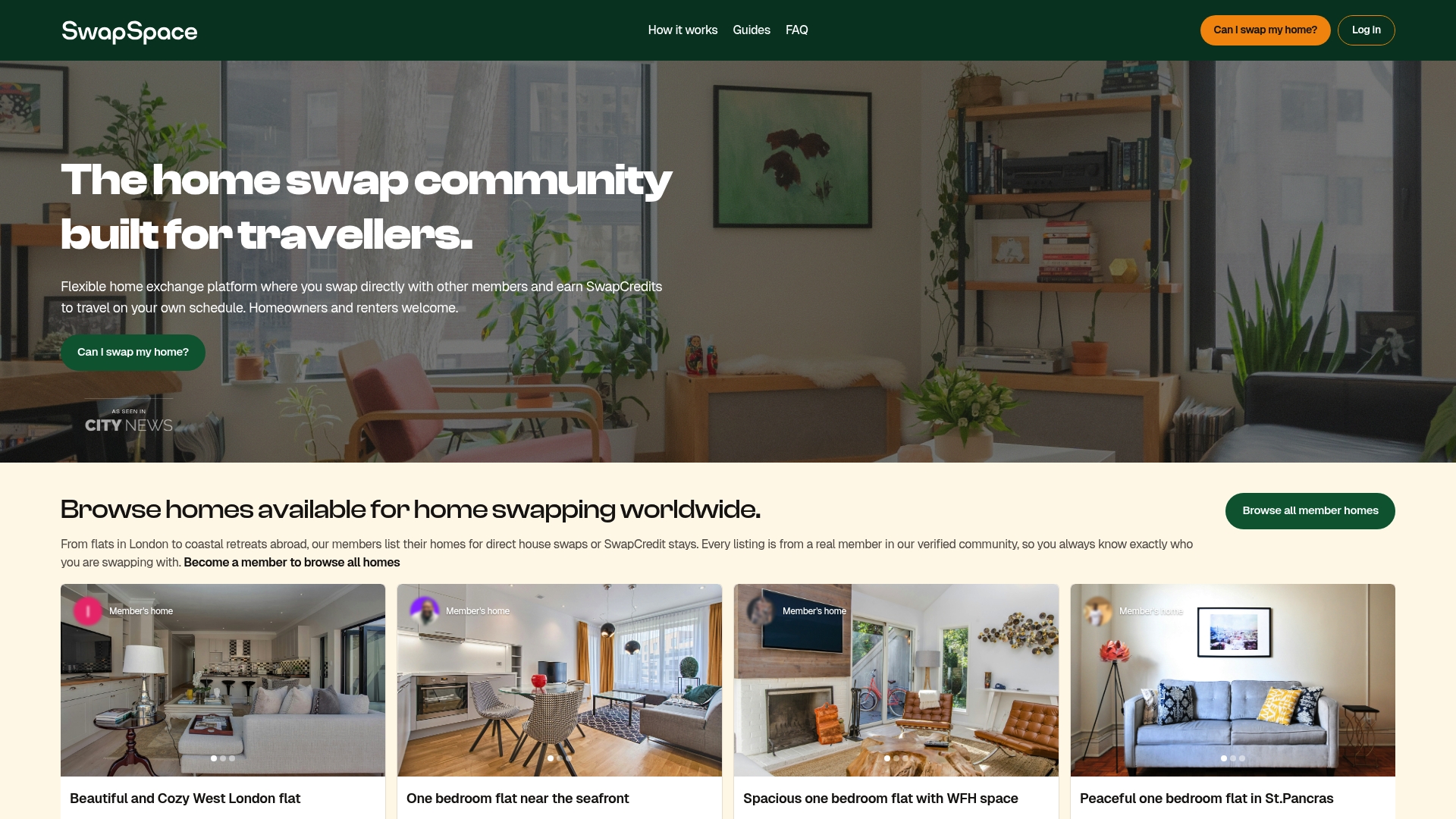
Explore how home exchange works step by step, or use the travel cost calculator to see exactly how much your next trip could cost compared to traditional accommodation. The platform is free to join, and every member goes through identity verification before listing their home. Your first exchange could be closer than you think.
Frequently asked questions
Is home exchange safe for first-timers?
Home exchange platforms use verification, reviews, and direct communication to minimise risk, and many first-timers find the experience far more reassuring than they anticipated once they engage with the process.
Can renters join a home exchange?
Yes, provided your lease allows subletting or short-term guests; always check your contract explicitly and seek written consent from your landlord before proceeding.
How is home exchange different from home rental?
Home exchange is a swap or points-based stay where no money changes hands for accommodation, whereas rentals involve a direct financial payment to access someone else’s property.
What are the main types of home exchange?
The main types are simultaneous swaps, non-simultaneous swaps, points/credits exchanges, and hospitality stays where the host remains present during your visit.
How do I protect my home and valuables during an exchange?
Lock away valuables, agree clear house rules in writing, review your home insurance for third-party cover, and always conduct a video call to vet your exchange partner before confirming.
